Overview
|
This documentation covers our Open Source solver to build a model from scratch. We also provide off-the-shelf models to solve common planning problems. These can be found here. |
Timefold Solver can be used in two ways. Pick the approach that best fits your architecture:
Add the solver as a dependency and wire it into your application however you like. Use Spring Boot, Quarkus… or no framework at all. |
Run as a service (Preview) Deploy a fully isolated optimization service. This oppinionated approach reduces the amount of boilerplate code needed to get to a running application. |
| Embed as a library | Run as a service | |
|---|---|---|
Best for |
Embedding the solver into an existing application |
Running optimization as a standalone, isolated service |
Ease of use |
Requires manual wiring: you manage configuration, lifecycle, and integration |
Minimal setup: the framework handles REST endpoints and lifecycle for you |
Integration |
You control how the solver is wired into your application. Integrations for Spring Boot and Quarkus available. |
Opinionated, ready-to-run service built on Quarkus |
Flexibility |
Use any framework or no framework at all |
Constrained by design, the service only runs optimization |
Status |
Stable |
Preview |
Embed as a library
The library approach gives you the solver core as a dependency. You integrate it into your application however you see fit. There are no constraints on your application framework or architecture.
The following getting started guides demonstrate the library approach:
-
-
The simplest starting point. Build a plain Java or Kotlin application with no additional framework.
-
-
-
Build a REST application with Java or Kotlin on top of Quarkus, a popular Java platform that supports native compilation.
-
-
-
Build a REST application with Java or Kotlin on top of Spring Boot, a popular Java platform that supports native compilation.
-
All three guides optimize a school timetable for students and teachers:
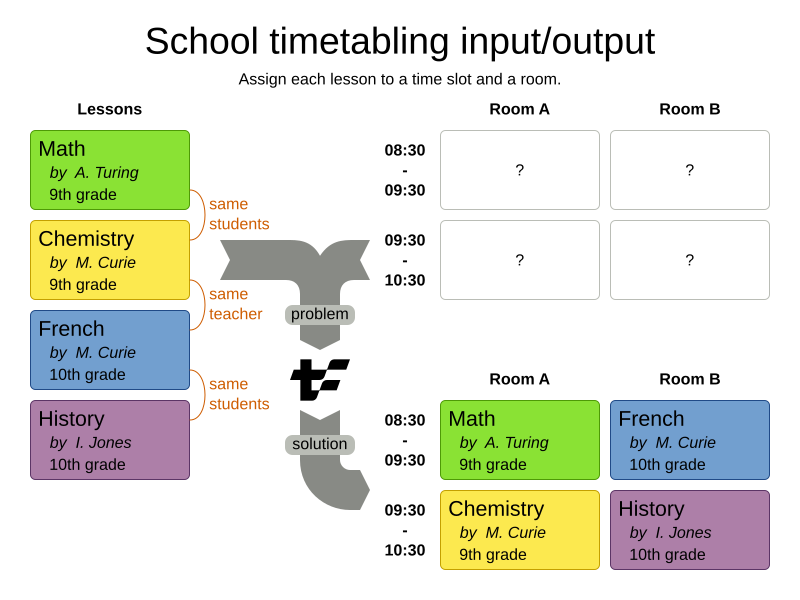
| The timefold-quickstarts repository contains the source code for all these guides. |
For additional use cases using the library approach,
take a look at the timefold-quickstarts GitHub repository.
Run as a service (Preview)
|
The service approach is currently in preview. It is the recommended path going forward, but the API may still change before it reaches general availability. |
The service approach takes an opinionated stance: it builds a fully independent optimization service on top of Quarkus. The service has a single responsibility, running optimization, and exposes it over a well-defined API. You do not need to manage solver lifecycle, thread pools, or result handling yourself.
This approach is the right choice when you want to:
-
Decouple optimization from the rest of your application
-
Scale the optimization service independently
-
Adopt a clean service boundary without boilerplate
To get started with the service approach, see Getting started: building a service.